• Somaliland National Disaster Preparedness and Food Reserve Authority (NADFOR)
  • Facebook
  • Twitter
  • Youtube
  • Instagram
  • Sun , April 12 2026
  • Visit Somaliland Government Portal
  • FAQs
    • English
    • عربى
    • Somali
Somaliland National Disaster Preparedness and Food Reserve Authority (NADFOR)
  • Facebook
  • Twitter
  • Youtube
  • Instagram
  • Home
  • About Us
    • About NADFOR
    • Top Management
    • Departments
      • Department of Administration and Finance
      • Planning, research and Statistics Department
      • Coordination
      • NADFOR Structure
      • Disaster Preparedness
      • Department of Relief & Islamic Relation
      • Human Resource
    • Priorities
  • Achievements & Programs
    • Achievments
    • Programs
  • Coordination meetings
  • Publications
    • Legislations
    • Regulations
    • Reports
    • Policies
    • Strategies
  • Media
    • News
    • Gallery
    • Press Releases
    • Events
  • Contact us
  • English
  • العربية
  • Somali

Reports

NADFOR REGIONAL Drought Early Warning - Monthly Bulletin Issued On 28th September 2022

NADFOR REGIONAL Drought Early Warning - Monthly Bulletin Issued On 28th September 2022


NADFOR produces Drought Early Warning-Monthly Bulletin in close collaboration with district disaster management committees (officers of line ministries, community early warning committees, and etc). This is the outcome of data collected by the Village/community EWCs under regional districts who monitor the key early warning indicators. 


Targeting Regions: Awdal, Marodijeeh, Sahil, Togdheer, Sool and Sanag regions:

Monthly drought field monitoring regularly takes place in the end of every month to assess the current situations of the country and collecting data from all the early warning indicators (Rainfall performance, Water availability and accessibility, Pasture and browse conditions, Livestock body conditions, Livestock migration pattern, Milk availability, Outbreak of diseases, Agricultural current situations, and Terms of trade, as well as Environment Issues or uncertainty risk).

Weekly weather forecast for Somaliland.

Headline: Wetter than usual conditions expected over most parts in the eastern regions of

Somaliland. 

Rainfall Forecast 04 - 11 October 2022: Moderate rainfall (50—200mm) expected over most parts of Somaliland especially for those areas in the eastern regions whereas less than 50mm of rainfall is expected over the western parts of Somaliland, according to the ICPAC weekly weather forecast


  • DownloadView

NADFOR produces Drought Early Warning-Monthly Bulletin in close collaboration with district disaster management committees (officers of line ministries, community early warning committees, and etc).


NADFOR produces Drought Early Warning-Monthly Bulletin in close collaboration with district disaster management committees (officers of line ministries, community early warning committees, and etc). This is the outcome of data collected by the Village/community EWCs under regional districts who monitor the key early warning indicators.


Targeting Regions: Awdal, Marodijeeh, Sahil, Togdheer, Sool and Sanaag regions:


Monthly drought field monitoring is regularly undertaken in the end of every month to assess the current situations of the country and collecting data from all the early warning indicators (Rainfall performance, Water availability and accessibility, Pasture and browse conditions, Livestock body conditions, Livestock migration pattern, Milk availability, Outbreak of diseases, Agricultural current situations, and Terms of trade, as well as Environment Issues or uncertainty risk).

  • DownloadView

A Drought Early Warning-Monthly Bulletin produced by NADFOR. This is the outcome of data collected by the regional teams led by  coordinators of NADFOR, with the  support of  Village


A Drought Early Warning-Monthly Bulletin produced by NADFOR. This is the outcome of data collected by the regional teams led by  coordinators of NADFOR, with     the     support     of     Village/     Community     Disaster     Risk     Management Committees{CDRMC} and District officers of line ministries, who monitor the Key Early Warning Indicators. These EW-indicators include: 
1.    Rainfall performance. 
2.    Water availability and accessibility 
3.    Pasture and browse conditions. 
4.    Livestock body conditions
5.    Livestock migration pattern.
6.    Milk availability. 
7.    Outbreak of diseases 
  Market conditions. 
8.    Terms of trade. 
9.    Environment Issues and uncertainty risk.
  • DownloadView

A Drought Early Warning-Monthly Bulletin produced by NADFOR. This is the outcome of data collected by the regional teams led by coordinators of NADFOR, with the support of Village/ Community


A Drought Early Warning-Monthly Bulletin produced by NADFOR. This is the outcome of data collected by the regional teams led by  coordinators of NADFOR, with the          support       of      Village/       Community      Disaster      Risk Management Committees{CDRMC} and District officers of line ministries, who monitor the Key Early Warning Indicators. These EW-indicators include:

  1. Rainfall performance.
  2. Water availability and accessibility
  3. Pasture and browse conditions.
  4. Livestock body conditions
  5.  Livestock migration pattern
  6. Milk availability.
  7. Outbreak of diseases
  8.  Market conditions.
  9. Terms of trade.
  10. Environment Issues and uncertainty risk.
  • DownloadView

Late in November, the National Disaster Preparedness and Food Reserve Authority (NADFOR) released a report revealing the current drought situation as a result of the poor performance of Gu rainy .

Late in November, the National Disaster Preparedness and Food Reserve Authority (NADFOR) released a report revealing the current drought situation as a result of the poor performance of Gu rainy season and the failures of Deyr rainy season, which resulted in a widespread drought situation across the country, particularly in the eastern regions. The 83th Cabinet Ministries meeting the President of the Republic of Somaliland H.E. Muse Bihi Abdi nominated the National Drought Committee (NDC), which is chaired by the Vice President

The NDC has conducted drought rapid assessment in all the regions in Somaliland in between 19 to 31 December 2021, identified that there is a severe shortage of water and pasture in the assessed locations/districts of the Eastern regions (Togdheer, Sool, and Sanaag) and Hawd of Marodijeeh region, whereas the Guban districts, particularly the coastal and sub-coastal areas of the Awdal and Sahil regions, have adequate water but face severe pasture and food shortages. This rapid assessment was commissioned National Drought Committee (NDC) with the collaboration of international partners.


The Rapid assessment stated that the drought is affecting 810,000 people currently, who require immediate assistance (Water, Food, and health services). If the drought continues in the coming four months, the report projects that the drought-affected population will climb to 49% increase, making 1,200,420 people affected
  • DownloadView

SOMALILAND DROUGHT RAPID ASSESMENT REPORT & SOMALILAND DROUGHT DECLARATION

EXECTUTIVE SUMMARY                                                                               

A combination of two consecutive dry seasons that resulted with severe water shortages, and rising food prices have left Somaliland citizens mostly severely drought affected in the country. The intensity of the drought has led to water shortages, crop failures, and scarce pasture for livestock. 


Overall, the rapid assessment findings shows that severity is higher in Togdheer, Sool and Sanaag regions, and some parts of Marodijeh, Sahil and Awdal regions with current people who are at critical situation in need of emergency assistance hits 810,000 person and should the current drought conditions maintain in the next coming two to three months. The number of affected people will be 1,200,420 persons across all the six main regions in Somaliland. The top priority needs of the people affected to date are mainly water (70%), Food (21%) and Health (9%).  


In addition, Population experienced abnormal migration influx in search of food, water, and pasture, is on the increase, with reports of new arrivals and departures including in the last one month. Access to water remains very limited, the available Berkeds and shallow wells in most locations have dried up due failed rainy seasons. Food and water prices increasing across the regions while livestock market prices are decreasing considerably. Livestock access to water is extremely worsening across the country and the situation is highly expected to worsen in the first quarter of 2022.


  • DownloadView
  • DownloadView

NADFOR Drought Early Warning - Monthly Bulletin Issued On 28th December 2021

A Drought Early Warning-Monthly Bulletin produced by NADFOR. This is the outcome of data collected by the regional teams led by  coordinators of NADFOR, with the support of Village/ Community Disaster Risk Management Committees{CDRMC} and District officers of line ministries, who monitor the Key Early Warning Indicators. These EW-indicators include:
 

  1. Rainfall performance.
  2. Water availability and accessibility
  3. Pasture and browse conditions.
  4. Livestock body conditions
  5. Livestock migration pattern
  6. Milk availability.
  7. Outbreak of diseases
  8. Market conditions.
  9. Terms of trade.
  10. Environment Issues and uncertainty risk.
  • DownloadView

NADFOR-MEWS-MONTHLY-BULLETIN ON SANAAG REGION 0n 30th December 2021

NADFOR Produces Drought Monthly Bulletin in Collaboration with Shaqodoon through Funding of Oxfam. This drought monthly report is collected by CBDRM-committees with support of focal persons, who monitor key indicators of drought early warning. Targeting villages:  Balanbaal, Ceelcadde, Dhoomo, Il-Libaah, Huluul, Faraguul, Dhoobo-Cantuug, Gawseweyne, Shiisha and Tuur-B.
 

 The Key Early Warning indicators include:

  1.  Rainfall,
  2. Water level
  3. Pasture Availability,
  4. Market condition and Terms of trade
  5. Emergency  message recorded
  • DownloadView

State of Drought Condition in S/land: An Assessment Report Conducted in Eastern Regions and M/Jeex Region

  1. Executive Summary
  • Pre-drought conditions, including depleted berkeds and shallow wells, as well as a loss of pasture, were observed during the assessment, especially in Sool, Sanaag and Togdheer regions.
  • 50% of assessed communities reported displacement of populations related to water shortage, which took place since October 2020. At least, an estimated 17,700 people in the 20 assessed locations have been Migrated due to poor Deyr rain in the past 2 -3 months.
  • Out of 40 communities covered by the assessment, it was reported that there are 118 shallow wells, of which only 29 have some water (25%). Besides, 27 % of assessed Berkeds are already depleted and 25 % have less than half of water.
  • In all communities assessed in Sool, Sanaag and Togdheer, the water price per jerrican has increased compared to the normal time. On average, the price of water per jerrican is now 2.6 times higher than before.
  • 85% of the assessed communities raises concerns over the lack of water for livestock, and 83% of the communities expressed a lack of pasture.
  • More than half of the assessed communities estimate that due to the current poor Deyr rain, most of the pasture would dry up. More concerns were raised among the communities in Togdheer region in which 80% of assessed communities consider that the situation is critical.
  • 13 out of 40 assessed locations (33%), the community reported an increase in waterborne diseases in the last four weeks.
  • As of December 2020, although the current situation is not yet the peak of the drought, the risk of the deterioration of drought in the coming months (early 2021) is very high. The immediate response of water provision, as well as anticipatory and early actions, are necessary to mitigate the shocks.
  • DownloadView

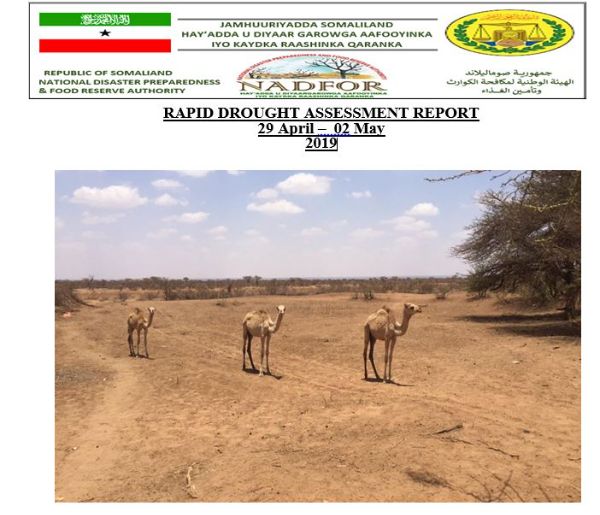
RAPID DROUGHT ASSESSMENT REPORT 29 April – 02 May 2019

1.   INTRODUCTION/BACKGROUND


This drought assessment was launched after consecutive rainfall failures (Deyr 2018 and Gu 2019) were observed and widespread water and food shortages were reported in many regions of Somaliland. The major objective of the assessment was to find out the current drought conditions in regions of Somaliland, especially in the key hotspot areas, the impact of the reported drought conditions and the most critical needs of the people affected (host community as well as IDPs). The hotspot areas were identified by the government of Somaliland (represented by NADFOR) and coordinated with the sub-sectors and humanitarian partners. The assessment was also expected to reveal the food security situation, water accessibility, and the status of education especially the school attendance status of young boys and girls.


2.   OBJECTIVES OF THE ASSESSMENT


•    To  assess  the  severity  of  the  drought  conditions  in  hotspot  areas  in  Somaliland  given  the underperformance of the Deyr 2018 and the Gu 2019 rains.

•    To assess the current food security situations including availability, accessibility & utilization among the IDPs and host community.

•    To assess the availability of water as well as the status of water sources including access to water by the local population, and practice regarding hygiene & sanitation.

•   To identify potential risk concerns that women, men & youth in IDPs and host community may face.

•    To assess the current shelter/NFI’s needs and observe education conditions of people in hot spot areas.

•    To assess displacement trends and  identify gaps and needs of the displaced population living in settlements, including needs for the provision of Camp Management services

•    To identify gaps and understand the priority needs of vulnerable communities for an appropriate and coordinated response.

  • DownloadView
  • << First
  • < Previous
  • 1
  • 2
  • 3
  • Next >
  • Last >>

Latest Updates

  • Mar 30, 2026

    FOOD DISTRIBUTED REPORT PUBLSHED NADFOR- 30 MARCH 2026

  • Mar 30, 2026

    NADFOR RELEASED MONTHLY DROUGHT EARLY WARNING BULLETING REPORT

  • Mar 11, 2026

    REGIONAL MOBILE EARLY WARNING SYSTEM (MEWS) MONTHLY DROUGHT EARLY WARNING BULLETIN

  • Mar 02, 2026

    Strengthening Humanitarian Response to Drought in Somaliland

  • Dec 20, 2025

    URGENT HUMANITARIAN APPEAL FOR DROUGHT RESPONSE AND RECOVERY

  • Jul 07, 2025

    This report is produced with input from regional teams, mobile app data, NADFOR coordinators, and grassroots Community Early Warning Committees. Covering six key regions—Awdal, Maroodijeeh, Sahil, Tog

  • Links

    • Home
    • Feedback
    • FAQs
Visit Somaliland Government Portal
  • Copyright
  • Privacy
  • Disclaimer
  • Terms & Conditions
  • Powered by : Ministry of ICT
    • Like Us on
      Facebook

    • Follow Us on
      Twitter

    • Subscribe on
      YouYube

    • Follow Us on
      Instagram